Like so many Viennese stories, this one begins with a legend. In 1832 Prince Metternich is said to have ordered a special dessert from his kitchen, and because the head cook was ill, the 16-year-old apprentice Franz Sacher stepped in. “Dass er mir aber keine Schand’ macht, heut’ Abend!”, don’t you shame me tonight, the prince is supposed to have said. The Wien Geschichte Wiki calls this a much and gladly retold story and thinks it more likely that the cake was created in the 1840s, when Sacher was working in Hungary.
From the hotel kitchen to Demel
His son Eduard Sacher is said to have refined the cake during his apprenticeship at the court confectioner Demel; later he founded the Hotel Sacher behind the Opera. When the hotel went bankrupt in 1934, Eduard Sacher junior gave the recipe to Demel, and with that the stage was set for one of Austria’s best-known legal disputes.
The cake war
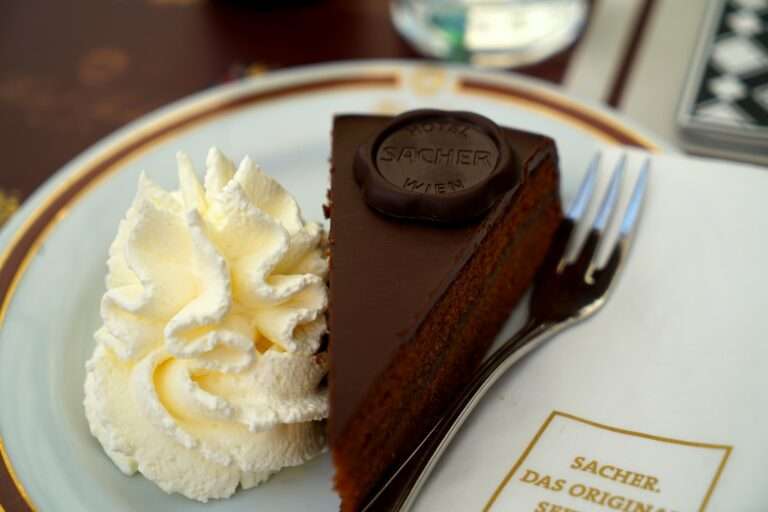
For years Hotel Sacher and Demel fought in court over who was entitled to the name “Original Sacher-Torte”. In 1961 even the writer Friedrich Torberg, a regular at both houses, was called as a witness. He testified that in Anna Sacher’s day the cake had never been cut open and filled with jam. In 1963 the two sides settled: the hotel sells the “Original Sacher-Torte” with a round chocolate seal, while Demel sold the “Eduard-Sacher-Torte” with a triangular seal, today “Demel’s Sachertorte”. Traditionally the two also differed in the jam: at Sacher the cake is cut and filled with apricot jam in the middle, while Demel’s classic version had it only under the glaze. Today Demel adds a layer in the middle too.
The proof of the cake
Which one you prefer is best decided by you, ideally with a cup of coffee on the side. On our Viennese coffee house tour cake is naturally part of the programme, and our tour of the imperial purveyors tells of the houses that once supplied the imperial court.