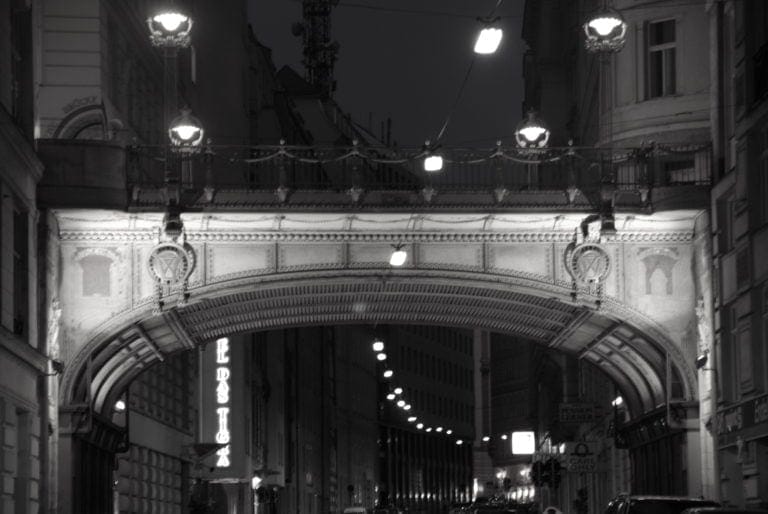
Today the Graben is one of Vienna’s most elegant addresses, with its plague column, jewellers and coffee houses. In the 18th century it drew a different crowd in the evenings. In the time of Joseph II, the women who strolled up and down here after dusk, waiting for customers, were mockingly called “Grabennymphen”, the Graben nymphs. A dropped handkerchief was enough to start a conversation.
The woodcock’s flight
In 1784 the Viennese engraver and publisher Hieronymus Löschenkohl brought out a print of the Graben nymphs with the telling subtitle “oder Der Schnepfen-Strich”. It was a pun for insiders. Woodcocks, Schnepfen in German, fly at dusk, hunters call their flight path the Strich, and at dusk the “Schnepfen” of the Graben appeared as well. The word Strich for street prostitution is older than Joseph II, though. It can be traced back to the 17th century and comes from streichen, to roam. Ignaz Castelli’s dialect dictionary of 1847 defines the “Schdrich” as “the lane and the line on which the whores show themselves”.
In Vienna people like to tell you that the authorities drew chalk lines on the pavement to keep order among the street walkers, and that this is where the German expression “auf den Strich gehen” comes from. It is a charming story, but there is no evidence for it.
A pocket book with a wink
In 1787 a “Taschenbuch für Grabennymphen auf das Jahr 1787” appeared anonymously, a satire in the style of the popular almanacs, attributed to Joseph Richter. It ironically praises the nymphs for providing a living for half the medical faculty. Maria Theresa had already tried to tackle loose morals with a Chastity Commission of her own. It existed only from 1752 to 1753 and was mostly laughed at abroad.
The Graben today
Today you stroll along the Graben past the windows of former purveyors to the imperial court, and many a story is just around the corner. On our tour of hidden Vienna and our special tour of the imperial purveyors we show you the old town from its lesser-known side.